There is a particular kind of excitement when a guide says wild dogs have been found in Madikwe.
Unlike a lion resting beneath a tree or an elephant feeding quietly beside the road, an African wild dog sighting can change in seconds. A pack may be sleeping in the shade, then rise into an energetic greeting ritual and suddenly begin moving through the bush. Within minutes, they can disappear across kilometres of wilderness.
The African wild dog (Lycaon pictus), also known as the painted dog or painted wolf, is one of Africa’s rarest large carnivores. The IUCN SSC Canid Specialist Group classifies the species as Endangered and estimates roughly 6,600 adults across 39 subpopulations, including only about 1,400 mature individuals; it also reports that the overall population continues to decline.
That makes Madikwe Game Reserve particularly significant. Wild dogs were reintroduced here during the reserve’s ambitious restoration programme, Operation Phoenix, and Madikwe today supports multiple resident packs. The reserve’s official information currently describes three hunting packs, although wild dog pack composition and numbers can naturally change over time.
For guests at Jaci’s Private Lodge, these animals form part of a much broader Madikwe wildlife experience that extends beyond the traditional Big Five to include cheetah, spotted and brown hyena and African wild dog. Jaci’s has been based in Madikwe since 2000 and explores the reserve on twice-daily guided game drives in open safari vehicles.
Why African wild dogs are so special
An African wild dog is unmistakable once you know what you are looking at. Lycaon pictus is a distinct African canid rather than a feral form of domestic dog. Its accepted English names include African wild dog, painted hunting dog and Cape hunting dog, while the scientific name refers to its painted appearance.
Their real fascination, however, lies in the way they live.
African wild dogs are intensely social animals. Packs usually contain a breeding pair, other adults and younger animals, and cooperation extends well beyond hunting. Research into wild dog breeding has documented pack members helping to provision pups, including returning to dens and regurgitating food for them. Larger packs can spread the considerable work involved in feeding and protecting offspring among more helpers.
That cooperation also shapes the hunt. Studies have shown that larger hunting groups can increase the range and size of prey that wild dogs are capable of taking, while sharing food allows pack members to benefit even when individual animals have not made a kill themselves. Their prey is predominantly medium-sized ungulates, although the exact species and hunting strategy vary between ecosystems.
One frequently repeated safari statistic claims that African wild dogs succeed in around 70–80% of hunts. The scientific picture is more interesting than that headline suggests. Hunting success depends heavily on habitat, prey, pack size and how a “hunt” is defined. Research on a pack in woodland savanna in Botswana, for example, recorded an individual attack success rate of only 15.5%, but the pack still achieved an effective feeding strategy through multiple short attacks and food sharing. It is therefore more accurate to describe wild dogs as exceptionally effective social hunters than to assign them one universal success percentage.
Their social lives can be surprisingly sophisticated too. Research on free-ranging African wild dogs in Botswana found that rapid nasal exhalations resembling “sneezes” were associated with whether a pack left a resting area after a social rally. More sneezes increased the likelihood of the group moving, and the threshold changed depending on whether dominant animals participated — effectively creating a form of collective decision-making.
A wild dog safari is therefore not simply about seeing a rare predator. It is an opportunity to watch one of Africa’s most socially complex carnivores functioning as a family.
The story of wild dogs in Madikwe Game Reserve
To understand why African wild dogs matter so much in Madikwe, it helps to understand how the reserve itself came into existence.
Before Madikwe became a protected wilderness, much of the area consisted of degraded cattle farmland. Following studies into how the land could create greater ecological and economic value, wildlife conservation and tourism were chosen as a new direction. Operation Phoenix subsequently moved more than 8,000 animals representing 28 species into the newly established reserve over approximately seven years.
African wild dogs were part of that extraordinary restoration story. Madikwe’s official reserve information records the introduction of a founding group of six wild dogs in 1994, while its Operation Phoenix history identifies their establishment in a fenced reserve as one of the pioneering achievements of the reintroduction programme.
Their recovery was anything but straightforward.
The founding population had to contend with competition and mortality associated with other predators as well as infectious disease. Madikwe’s reserve history specifically records territorial encounters, lion interactions and rabies outbreaks as significant challenges faced by the population.
Madikwe subsequently became important not only as wild dog habitat but also as a real-world case study in carnivore conservation.
A published investigation into a rabies outbreak in Madikwe in 2000 found that 10 of 12 eight-month-old pups died or disappeared. Importantly, five vaccinated adults survived the outbreak, providing evidence that repeated vaccination could offer protection against natural rabies exposure.
Rabies again affected wild carnivores in Madikwe in 2014–2015. Veterinary researchers confirmed rabies in two wild dogs and a spotted hyena and stressed the importance of disease surveillance, vaccination and regional rabies control because an endangered carnivore population can be severely affected by a single outbreak.
That history helps explain why the presence of wild dogs in Madikwe today should not be taken for granted.South Africa uses a broader managed metapopulation approach in smaller fenced reserves, moving animals between protected populations in ways that help mimic natural dispersal and preserve genetic diversity. A 20-year review found that this managed metapopulation was the only one of South Africa’s three major wild dog population components to have increased significantly over the study period, reflecting the importance of active conservation.
More recent genomic research published in 2026 provides further support for this approach. The study reports a managed South African population of roughly 150 adults and yearlings and found evidence that mixing animals from different populations can reduce inbreeding and genetic load, demonstrating why carefully planned translocations are more than simply moving animals from one reserve to another.
Madikwe is therefore part of a much larger effort to ensure that geographically separated wild dog packs continue to function as components of a viable South African population rather than isolated genetic islands.
Why Madikwe is such an important place to look for wild dogs
Wild dogs still occupy only a fraction of their former African range. The IUCN SSC Canid Specialist Group identifies habitat fragmentation, conflict associated with human activities and infectious disease among the principal threats to their survival, while their ability to disperse over considerable distances makes even animals inside protected landscapes vulnerable to what happens beyond reserve boundaries.
Madikwe offers a comparatively secure protected landscape of approximately 750 km² in South Africa’s North West Province, close to Botswana. It encompasses grasslands, woodland, rocky areas and other habitat types, and supports the Big Five alongside cheetah and African wild dog.
The reserve’s official information currently reports three hunting packs and explicitly identifies African wild dog as one of Madikwe’s signature wildlife attractions. Because pack numbers, membership and territories can change, that figure should be understood as a current reserve description rather than a permanent population count.
Madikwe also does not permit ordinary day visitors, which reduces the volume of transient self-drive traffic found in some larger public safari destinations. Safari in Madikwe is therefore centred on lodge-based guided experiences rather than high-volume day tourism.
Together, multiple resident packs within a defined protected landscape and experienced guides who know the reserve well create favourable conditions for encountering wild dogs. Sightings, however, can never be guaranteed
The unpredictability is part of what makes finding them so rewarding.
Wild dogs can move over large areas. Outside the denning period they rarely stay in one place for long, and research on the species consistently shows extensive ranging and long-distance dispersal behaviour.
A morning may therefore begin with little more than tracks in the road. Then comes a report from elsewhere in the reserve, a change of direction, perhaps another set of spoor — and suddenly the pack is there.
What you may see when you find a pack
A wild dog encounter can take many forms.
During periods of rest, a pack may initially look remarkably peaceful. Animals lie close together, groom, shift positions and interact socially. Before moving away, that calm can transform into an energetic social rally involving close physical contact, vocalisation and excitement. Research has shown that these pre-departure rallies play an important role in coordinating collective movement.
If the pack begins hunting, the experience becomes completely different.
African wild dogs are cursorial predators capable of pursuing mobile prey, but modern research has challenged the simple image of every hunt being one long, perfectly coordinated endurance chase. Studies across different habitats show considerable flexibility: larger groups can improve hunting success and expand prey choices, while dogs in wooded environments may make numerous relatively short attacks rather than one extended coordinated pursuit.
Their principal prey consists largely of antelope and other ungulates. The Canid Specialist Group reports that although wild dogs themselves typically weigh around 20–30 kg, prey can average roughly 50 kg and may sometimes be substantially larger.
The pack’s social structure becomes especially apparent after a successful hunt and during breeding. Wild dogs are cooperative breeders, and studies have documented adults and yearlings provisioning pups by returning food to the den. Rather than parenting being restricted to a single mother and father, raising young becomes a pack-level undertaking.
This dependence on the group is one reason losing several animals can have consequences far beyond the individuals themselves. Pack size affects hunting, pup provisioning and survival, while disease outbreaks can reduce an entire social unit in a short period.
There is also another predator to watch whenever wild dogs are moving through Madikwe: lion.
Lions are not merely competitors for prey; they can kill wild dogs. Research into wild dog den selection and habitat use shows that avoidance of lions can influence where packs move and breed, and Madikwe’s own history records lion encounters among the challenges faced by its reintroduced population.
That interaction between predators is part of the ecological complexity that makes following wild dogs so interesting. A pack is constantly balancing prey, competitors, pups, territory and the need to remain together.
When is the best time to see African wild dogs in Madikwe?
There is no single season in which African wild dogs can be guaranteed. Madikwe offers wildlife viewing throughout the year, and Jaci’s notes that each season brings a different safari experience.
For overall game viewing, the dry winter months from roughly May to September are particularly rewarding. Vegetation becomes thinner and animals increasingly use permanent water sources, improving visibility across the reserve. Both Jaci’s and Madikwe’s reserve information identify the dry season as an especially productive period for wildlife viewing.
Winter can also overlap with an especially interesting stage of the wild dog’s annual cycle.
African wild dogs breed seasonally, and during denning their normal ranging behaviour changes dramatically. Research shows that a pack may use a den for approximately 10–12 weeks, contracting its range while adults repeatedly leave to hunt and return to provision pups. The timing differs between populations and years, so it is better to think of denning as a seasonal biological window rather than a fixed safari calendar date.
A den should never be treated simply as a tourist attraction. It is a sensitive nursery on which an endangered pack’s next generation depends, and viewing practices must be determined by reserve conservation protocols and guide judgement rather than by a guest’s desire to get closer.
Outside denning, greater mobility can make dogs more challenging to locate, but it also creates some of the most dynamic sightings as a pack travels, hunts and interacts across the reserve.
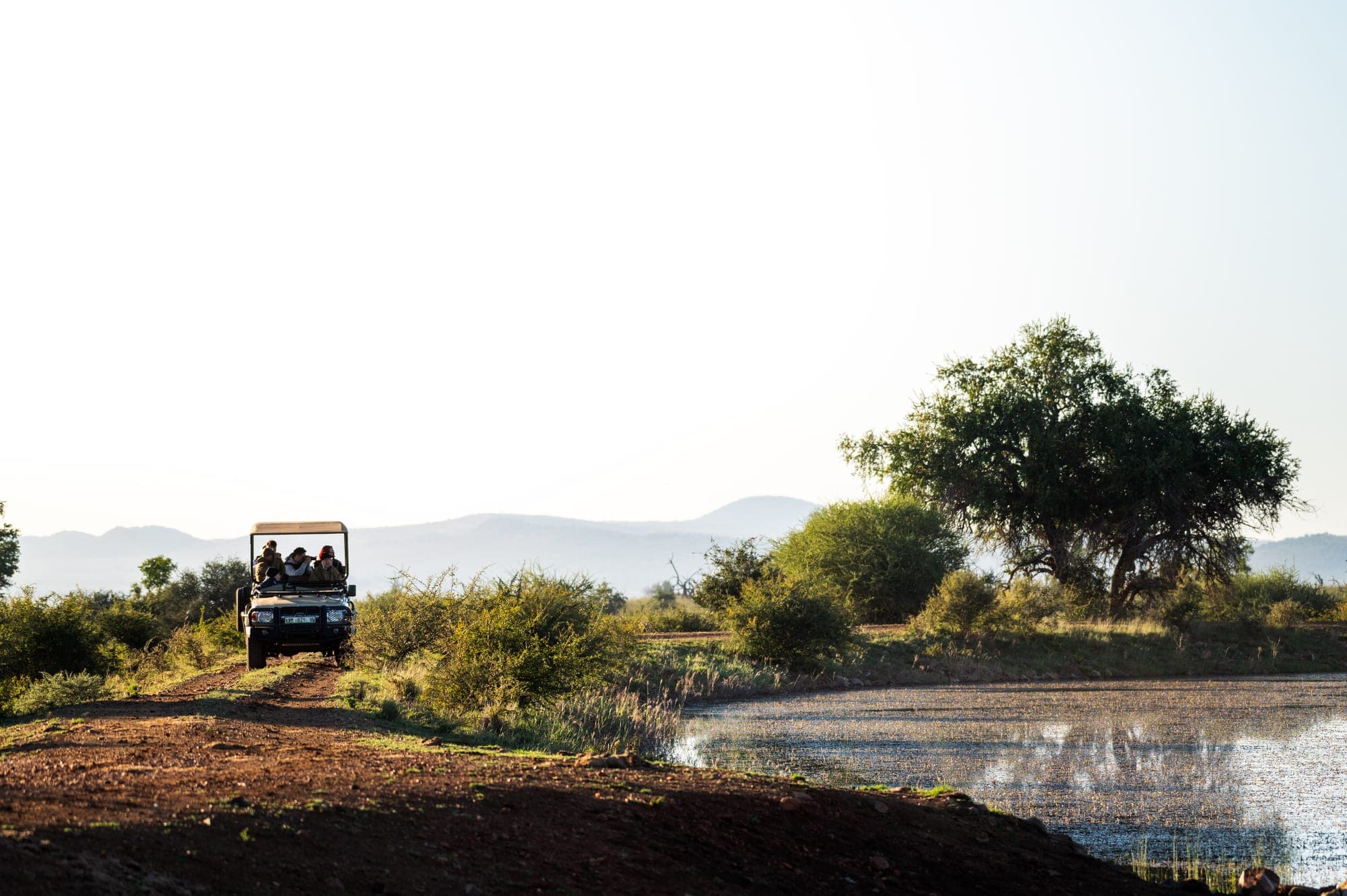
At Jaci’s, twice-daily game drives are conducted in the morning and afternoon with experienced guides using open safari vehicles. Those drive periods coincide with the cooler parts of the day when many large mammals and predators are active, while also providing the softer dawn and evening light valued by wildlife photographers.
And although winter may offer easier visibility, summer should not be dismissed. From approximately October to April the reserve becomes greener after seasonal rains, migratory birds arrive and young antelope add another dimension to predator-prey interactions.
The best approach is to visit Madikwe for the wider wildlife experience rather than for any single promised sighting, with African wild dogs remaining one of the reserve’s most exciting possibilities.
Seeing Madikwe’s wild dogs from Jaci’s Private Lodge
Jaci’s Private Lodge sits inside Madikwe Game Reserve, giving guests access to the reserve’s wider wildlife experience as part of guided morning and afternoon game drives. Jaci’s describes Madikwe’s wildlife offering as extending from the Big Five to wild dog, cheetah, both spotted and brown hyena, hippo and giraffe, alongside abundant general game and more than 350 recorded bird species.
For anyone specifically fascinated by wild dogs, the most rewarding approach is to tell your guide.
Finding them involves much more than driving around hoping a pack crosses the road. Tracks, recent movements, the behaviour of prey species and knowledge built up over repeated days in the same landscape all contribute to reading the bush. Jaci’s game drives are led by guides who interpret tracks, animal behaviour and ecology as part of the safari experience.
It is also worth staying interested after the pack has been found.
The obvious temptation is to wait for a hunt, but wild dogs are perhaps most revealing in the quie
ter moments: greeting each other after a rest, allowing youngsters into the centre of the group, responding to distant sounds, scent-marking, playing or deciding together that it is time to move. Scientific studies of wild dogs have shown that social bonds, hierarchy, communication, cooperative breeding and collective movement are fundamental to how the species survives.That makes an African wild dog encounter different from ticking another predator off a safari checklist.
Madikwe’s dogs are descendants of one of South Africa’s most ambitious conservation experiments. Their history includes reintroduction, disease, loss, recovery and continuing human intervention to maintain viable populations. The fact that visitors can now encounter resident packs travelling through a landscape that was cattle farmland only a few decades ago is itself part of Madikwe’s conservation story.
For Jaci’s guests, that is the real privilege of seeing African wild dogs in Madikwe: not simply encountering a rare animal, but witnessing a living conservation story still unfolding.
Frequently asked questions about African wild dogs in Madikwe
Are there African wild dogs in Madikwe Game Reserve?
Yes. African wild dogs were reintroduced to Madikwe in the 1990s as part of the reserve’s wildlife-restoration programme. The reserve’s official information currently describes three hunting packs, although pack numbers and composition can change over time.
Are African wild dogs endangered?
Yes. The IUCN SSC Canid Specialist Group lists Lycaon pictus as Endangered. Its current species account estimates approximately 6,600 adults in 39 subpopulations and identifies habitat fragmentation, human conflict and infectious disease among the principal threats.
Is an African wild dog the same as a painted dog or painted wolf?
These names refer to the same species, Lycaon pictus. The IUCN Canid Specialist Group lists African wild dog, Cape hunting dog and painted hunting dog among its recognised English common names.
Can you see wild dogs on safari at Jaci’s?
They are among the notable species living in Madikwe and are therefore possible to encounter on Jaci’s guided game drives. However, Jaci’s correctly states that individual wildlife sightings cannot be guaranteed.
When is the best time to see wild dogs in Madikwe?
Wild dogs can be encountered throughout the year. The dry May-to-September period generally provides particularly good overall wildlife visibility because vegetation is thinner, while seasonal denning can temporarily reduce the area travelled by breeding packs. Exact denning dates vary, however, and sightings remain dependent on animal movements.
Are African wild dogs part of the Big Five?
No. The traditional Big Five are lion, leopard, elephant, rhino and buffalo. Madikwe also supports wild dog and cheetah, which are sometimes added to the Big Five to create the informal safari concept of the “Super Seven”.
Why are wild dogs important to Madikwe’s conservation story?
Their reintroduction formed part of Operation Phoenix, the wildlife-restoration programme that moved more than 8,000 animals from 28 species into the new reserve. Madikwe’s wild dogs subsequently became part of South Africa’s broader effort to conserve geographically separated populations through active metapopulation management.